
KfW 40 QNG: Certification, Costs and Funding
KfW 40 QNG combines efficiency level 40 with the QNG sustainability label and is the prerequisite for the highest new-build funding. This guide explains the QNG label, distinguishes KfW 40, KfW 40 QNG and the historical term KfW 40 Plus, contrasts extra costs and funding advantage as a range and describes the process with the sustainability adviser – as of 2026.
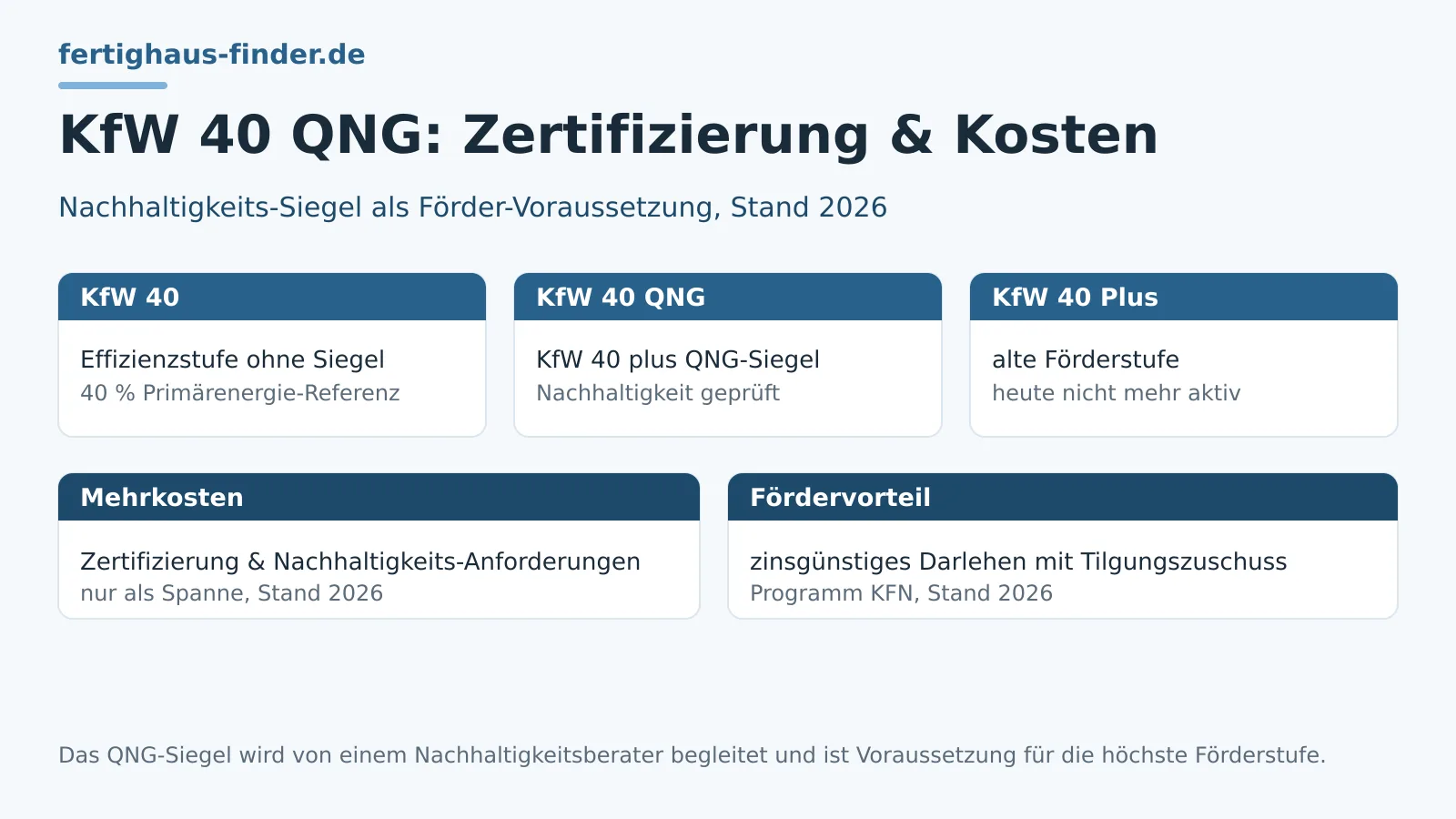
Anyone aiming for the highest funding with a prefab house quickly comes across the abbreviation KfW 40 QNG. Behind it lies not a new house type, but the combination of the Efficiency House 40 standard and a certified sustainability seal. As a rough guide, the QNG certification and the additional requirements add low single-digit percentages of the build cost as extra effort — in return, a considerably higher promotional loan beckons. This guide explains what the QNG seal is, how KfW 40, KfW 40 QNG and the historical term "KfW 40 Plus" differ, and what the process with a sustainability adviser looks like. How the extra effort and funding show up in the budget is shown by the prefab house prices 2026; you can work out your sum in the prefab house cost calculator.
What does the QNG seal mean for a prefab house?
Short answer: QNG stands for "Quality Seal for Sustainable Buildings" (Qualitätssiegel Nachhaltiges Gebäude). It confirms that a new build is not only energy-efficient, but meets certain requirements over its entire life cycle — ecologically, economically and socioculturally — for example on greenhouse gas emissions, the materials used and later dismantlability. It is awarded by accredited certification bodies on the basis of a state-recognised system. For the highest state new-build funding, a QNG seal has been the central prerequisite since the introduction of the "Climate-Friendly New Build" (Klimafreundlicher Neubau, KFN) programme.
The distinction is important: a KfW 40 standard describes only the energy quality — how much primary energy the house needs compared with a reference building. The QNG seal goes beyond that and considers the sustainability of the entire building. Only both together — efficiency level 40 and QNG — make up the funding case "KfW 40 QNG". Anyone dealing with the efficiency house standard in general will find the basics in the overview of the KfW 40 house and the technical details in the guide on the KfW 40 requirements. How the QNG seal fits into the larger context is shown by the guide on the sustainable prefab house. How the relevant programmes work is summarised by the overview of the KfW for house-building.
Two building blocks, one goal
Remember the rule of thumb: KfW 40 is the energy efficiency, QNG is the sustainability. Only when both proofs are in place is the highest funding level for the climate-friendly new build achievable. The seal is awarded on a building-specific basis, not across the board for a house type.
KfW 40, KfW 40 QNG and "KfW 40 Plus" – where is the difference?
Short answer: KfW 40 denotes the pure efficiency level. KfW 40 QNG supplements this level with the sustainability seal and is the prerequisite for the highest new-build funding. The formerly widespread term "KfW 40 Plus", by contrast, describes an older funding level with additional technical requirements such as a photovoltaic system with storage — this funding level no longer exists in its original form today, but still appears in older offers and search queries. Anyone who hears "KfW 40 Plus" almost always means either the historical programme or is confusing it with today's QNG requirement.
Terms in comparison (classification 2026)
| Term | What is meant | Current status |
|---|---|---|
| KfW 40 | pure energy-efficiency level | current, as a basis |
| KfW 40 QNG | KfW 40 plus sustainability seal | current funding prerequisite |
| KfW 40 Plus | older level with PV/storage requirement | no longer active in this form |
For practice this means: do not rely on old designations from brochures or forums. What is decisive is always the current funding guideline. So before every purchase decision, check the official conditions at the KfW and have the manufacturer confirm in writing which efficiency level and which seal the offered house concretely achieves. A general overview of grants and loans is offered by our subsidies guide.
Caution with 'KfW 40 Plus' in offers
If "KfW 40 Plus" appears in a current offer, ask specifically: is today's QNG requirement meant, or an outdated description? Only a clear, written commitment to the concrete efficiency level and the QNG seal gives you planning security for the funding.
Find a fundable prefab house
Whether KfW 40 with a QNG seal even makes sense depends on the house, plot and financing. Compare the offers of several prefab house manufacturers from our network free of charge and have the achievable efficiency level confirmed in writing.
Are the extra costs for KfW 40 QNG worthwhile?
Short answer: The QNG standard causes extra costs — through more sustainable materials, the life cycle assessment and the certification procedure itself. These can only be reliably stated as a range and depend heavily on the house type, fittings and manufacturer. Against this stand the funding through an interest-favourable KfW loan with a repayment grant, as well as permanently low energy costs. Whether the investment pays off is decided by the individual calculation: anyone who builds to a high standard and energy-efficiently anyway often recoups the extra costs to some extent through funding and operating costs.
Weighing extra costs and funding advantage (only as a range, as of 2026)
| Aspect | KfW 40 without QNG | KfW 40 QNG |
|---|---|---|
| Materials / proofs | standard | higher requirements |
| Certification costs | none | advice + seal |
| Extra build cost | none | range, project-dependent |
| Promotional loan (KFN) | lower / not applicable | highest level achievable |
| Operating costs | low | low |
We deliberately do not name concrete euro amounts, because funding rates, loan sizes and interest rates change and depend heavily on the individual case. Serious statements are only possible as a range with the addition "as of 2026". What is decisive is that you set the extra costs against the funding advantage in your own calculation — ideally together with the sustainability adviser and your financing bank. Only that way do you recognise whether the surcharge for the QNG seal is offset in your case by funding and savings.
How does certification with the sustainability adviser work?
Short answer: The QNG seal cannot be applied for retrospectively — it has to be planned in from the start. The central figure is a qualified sustainability adviser who accompanies the requirements from planning to completion and produces the necessary proofs. They coordinate the life cycle assessment, check materials and documentation, and ensure that at the end an accredited certification body can award the seal. Without this early accompaniment, the highest funding level is practically unachievable.
- Involve a qualified sustainability adviser early — before the building-application phase.
- Determine efficiency level 40 and the QNG requirements together with the manufacturer.
- Document the life cycle assessment and material proofs across the entire planning and construction process.
- Submit the funding application in good time and before the start of construction — the order is binding.
- Have the certification confirmed by an accredited body and keep the documents.
Clarify early whether your manufacturer has experience with QNG projects and whether the advice is included in the offer or has to be commissioned separately. Because the funding application generally has to be submitted before the start of construction, the order is decisive: first advice and application, then build. Anyone who muddles these steps risks the funding. Current details on the technical minimum requirements and permitted seal variants are published by the responsible federal ministry.
For whom is KfW 40 QNG the right choice?
Short answer: KfW 40 QNG is worthwhile above all for building families who want to build to a high standard and sustainably anyway and want to take the highest new-build funding. Anyone who shies away from the effort of certification or has a very tight budget is sometimes simpler off with an efficient house without QNG. The decision should always rest on an individual calculation that brings together extra costs, promotional loan and operating costs — together with the sustainability adviser and the bank.
Do not consider the QNG seal in isolation, but as part of your overall calculation. Work through the project including all ancillary costs and reserves and, in parallel, check the current funding conditions. The market for energy-efficient prefab houses is large, but the achievable standards vary considerably. So have several manufacturers confirm in writing which efficiency level and which seal are included in the concrete offer — this way you avoid nasty surprises with the funding application and make a decision that suits your budget and your sustainability goals.
Build sustainably and secure funding
A KfW 40 house with a QNG seal combines low energy costs with the highest new-build funding — if it is planned correctly from the start. We connect you free of charge to suitable prefab house providers from our network who have experience with fundable standards.
What does your dream house really cost?
Request suitable quotes from vetted manufacturers for free and compare the prices per square metre for your construction project.
Compare house prices now