
Residence status and buying property in Germany
Germany lets foreign nationals own property regardless of citizenship. What actually changes with your residence status is financing — the equity a bank expects and the loan-to-value it will offer. This guide explains EU versus non-EU differences, permanent versus temporary permits, buying from abroad, and how tax residency differs from a residence permit.
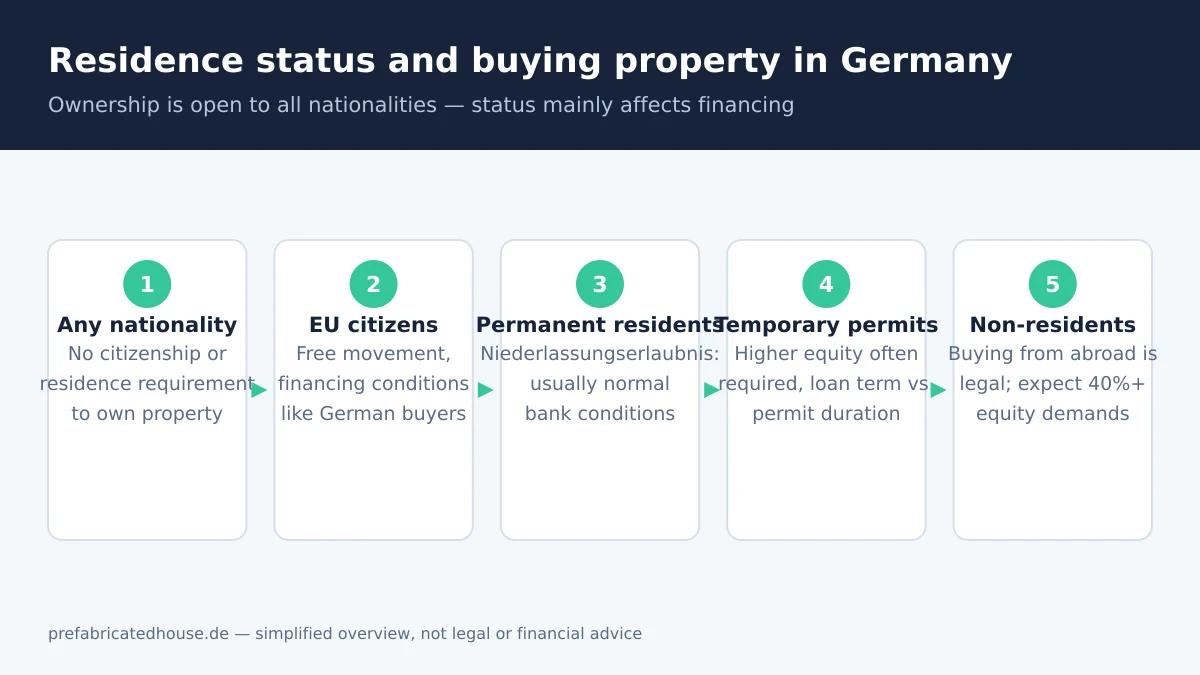
Anyone can own German property — status shapes the financing
The first thing to understand is reassuring: German law places no restriction on foreign ownership of real estate. There is no separate register for foreign buyers, no approval body you must satisfy, and no citizenship test attached to the ownership right. A citizen of any country — inside or outside the European Union, living in Germany or still abroad — can hold the freehold title to a plot of land or a house in exactly the same way a German national can. The legal act of transferring ownership happens before a notary (Notar) and is entered in the land register (Grundbuch) kept at the local court (Amtsgericht), following the same procedure for everyone.
Where your residence status genuinely matters is money. Banks are not regulating who may own; they are managing repayment risk over a long fixed-rate loan. Your legal right to remain in Germany, the currency and stability of your income, and how easily a lender can enforce against you all feed into the terms you are offered. The practical result is that two people buying the identical €400,000 house may face very different equity requirements: one might finance 85% of the price, the other only 60%, purely because of their residence and income profile. Everything below unpacks how the main status categories translate into those financing outcomes, and what changes when you buy without setting foot in Germany.
Throughout, remember that the taxes and one-off purchase costs are the same regardless of nationality. The real-estate transfer tax (Grunderwerbsteuer), the notary and land-registry fees and any agent commission do not rise because you are foreign. For a full breakdown of those figures see our property taxes and fees guide, and for the mechanics of the purchase itself our buying-as-a-non-resident guide.
Three things status changes
Ownership is nationality-blind
Any foreign national, EU or non-EU, resident or not, may own German property. Status affects financing terms, not the legal right to buy.
Permit type drives your LTV
Permanent settlement and EU status can reach roughly 80–90% loan-to-value; temporary permits often 50–70% with more equity required.
Buying from abroad is possible
A notarised power of attorney (Vollmacht) plus apostille lets a representative sign for you — allow 2–4 extra weeks for legalisation.
EU and EEA citizens versus non-EU nationals
For the ownership right, an EU citizen and a non-EU citizen stand on equal footing. The difference is one of underlying stability. Citizens of the European Union and the wider European Economic Area (EEA) enjoy freedom of movement: they may live and work in Germany without applying for any residence permit (Aufenthaltstitel), and their right to stay does not expire. From a lender's perspective this looks almost like a resident profile, which is why an EU buyer with German income can often be offered a loan-to-value of roughly 80–90%, subject to the individual assessment.
A non-EU national's position depends heavily on the permit they hold and where their income comes from. Someone on a stable job in Germany with a solid contract is treated very differently from a buyer who lives abroad and earns in a non-euro currency. Exchange-rate movements alone can push a lender to reduce the loan-to-value or add a small interest premium, because a currency swing of even 10–15% changes the real burden of a euro-denominated repayment. None of this touches the right to buy; it only shapes how much of the price you must bring as equity. For how those equity ranges work in detail, see our mortgage guide for expats.

Permanent settlement versus temporary permits
Among non-EU buyers, the single biggest financing factor is whether your permit is permanent or temporary. A temporary residence permit (Aufenthaltserlaubnis) is issued for a fixed period and tied to a purpose such as employment or study. Because it carries an expiry date, a bank planning a 10 or 15 year fixed-rate loan cannot be sure of your legal standing for the whole term. Lenders respond by lowering the loan-to-value — often to around 60–70% — and sometimes by adding a modest interest premium. This is a risk decision, not a legal barrier; you can still buy, you simply bring more equity.
A permanent settlement permit (Niederlassungserlaubnis) removes that expiry concern. It grants an unlimited right to live and work in Germany, so a holder is treated by most banks almost like a domestic borrower, with a loan-to-value that can approach 80–90%. Reaching this status usually takes around 5 years of legal residence with paid social-security contributions, although some skilled workers and graduates qualify after 21 to 33 months. If you are on a temporary permit now but expect to settle permanently, it can be worth timing a purchase — or at least the mortgage conversation — around that milestone.
The EU Blue Card and skilled-worker permits
A special case is the EU Blue Card (Blaue Karte EU), a residence permit for qualified professionals who earn above a set salary threshold — for many roles over €45,000 per year in 2026, with a lower floor for shortage occupations. Although a Blue Card is technically a temporary title, its holders tend to have well-documented, high and stable incomes, and a fast route to permanent settlement. Banks recognise this, and Blue Card holders are frequently offered terms closer to residents, with a loan-to-value in the region of 70–85%. The lesson across all permit types is consistent: the more durable and better-evidenced your right to stay and your income, the closer your financing moves to resident conditions.
Buying from abroad: apostille and power of attorney
You do not need to be in Germany, or even hold any German permit, to complete a purchase. The transaction still runs through a German notary, but you can be represented. The usual tool is a notarised power of attorney (Vollmacht) authorising a trusted person — a lawyer, a relative or the notary's own staff — to sign the deed and handle registration on your behalf. Because that document is created outside Germany, it must be made acceptable to the German system, which is where legalisation comes in.
For countries in the 1961 Hague Convention, a single certificate called an apostille confirms the document is genuine. For countries outside that system, the longer route of consular legalisation applies, involving your local German diplomatic mission. Either way you should budget an extra 2–4 weeks for the paperwork, and often a certified translation on top, since the notary needs to read the deed with you in a language you fully understand. If you attend in person without fluent German, a sworn interpreter (Dolmetscher) must be present at the appointment. Plan these steps early: the legalisation chain, not the German side, is usually what slows a cross-border purchase.
The rest of the mechanics — the priority notice (Auflassungsvormerkung) that reserves the plot, the escrow-style payment flow and the final land-register entry — work exactly as they do for a resident. Practical details of those steps are set out in our non-resident buying guide, and the German Civil Code (BGB) rules behind them are available in an official English translation of the BGB.
Tax residency is not the same as a residence permit
One of the most common sources of confusion is the difference between your immigration status and your tax status. A residence permit is an immigration matter decided by the foreigners' authority (Ausländerbehörde) and it governs your right to live in Germany. Tax residency is a separate question decided under German tax law. In broad terms, you become subject to unlimited German income tax if you keep a home available to you in Germany, or if you spend more than 183 days in the country during a calendar year — a threshold known as habitual abode. It is entirely possible to be tax-resident without holding any permit, or to hold a permit while remaining taxed in another country.
This distinction matters for buyers because owning and using a German home can itself create or strengthen a tax presence. If you rent the property out, the rental income is taxable in Germany regardless of where you live, and you will need your German tax identification number (Steuer-Identifikationsnummer) to declare it. Double-taxation treaties usually prevent you being taxed twice on the same income, but the way they allocate taxing rights varies by country. Because the interaction of immigration status, tax residency and treaty rules can be intricate, confirm your position with a German tax adviser (Steuerberater) before you sign — a single consultation costing a few hundred euros can prevent much larger mistakes. For the property-related taxes themselves, our taxes and Grunderwerbsteuer guide has the detail.
Real-estate transfer tax by federal state (as of 2026)
The real-estate transfer tax (Grunderwerbsteuer) does not depend on your nationality or residence status — only on the federal state where the plot lies. As of 2026 the 16 states charge between 3.5% and 6.5% of the purchase price.
| Federal state | Grunderwerbsteuer |
|---|---|
| Baden-Württemberg | 5.0% |
| Bavaria (Bayern) | 3.5% |
| Berlin | 6.0% |
| Brandenburg | 6.5% |
| Bremen | 5.0% |
| Hamburg | 5.5% |
| Hesse (Hessen) | 6.0% |
| Mecklenburg-Western Pomerania (Mecklenburg-Vorpommern) | 6.0% |
| Lower Saxony (Niedersachsen) | 5.0% |
| North Rhine-Westphalia (Nordrhein-Westfalen) | 6.5% |
| Rhineland-Palatinate (Rheinland-Pfalz) | 5.0% |
| Saarland | 6.5% |
| Saxony (Sachsen) | 5.5% |
| Saxony-Anhalt (Sachsen-Anhalt) | 5.0% |
| Schleswig-Holstein | 6.5% |
| Thuringia (Thüringen) | 5.0% |
Rates as of 2026, provided without warranty. States can change their rates — confirm the current figure for the state where your plot lies.
Worked example: a €400,000 purchase
Imagine you buy a house and plot for €400,000. Because the tax is charged on the purchase price, your bill depends only on the state:
- In Bavaria at 3.5%, the transfer tax is €14,000.
- In Saxony-Anhalt at 5.0%, it is €20,000.
- In North Rhine-Westphalia at 6.5%, it is €26,000.
On top of the transfer tax, add notary and land-registry (Grundbuch) fees of roughly 1.5–2% — about €6,000–€8,000 on this price — and any agent commission. Altogether, ancillary purchase costs in Germany typically reach around 9–12% of the price. Try your own figures in the cost calculator.
Keep reading
Buying as a non-resident
The plot-purchase process, the notary and the land register, step by step.
Read moreMortgage for expats
Realistic loan-to-value, Schufa and the documents German banks request.
Read moreProperty taxes & fees
Grunderwerbsteuer by state, notary and land-registry fees, annual Grundsteuer.
Read moreBuilding permit in Germany
How the building permit (Baugenehmigung) works and what it means for your timeline.
Read moreWhatever your status — request prefab offers
- Free & non-binding
- SSL-encrypted
- Reply within 24 h
Which type of prefab house fits your plans?
Personal reply within 24 hours
FAQ: residence status and buying property in Germany
Answers on citizenship, EU versus non-EU differences, permit types, the Blue Card, buying from abroad and tax residency — general orientation for 2026, not legal or tax advice.
Do I need German citizenship to buy a house in Germany?
Is buying easier for EU citizens than for non-EU citizens?
How does a temporary residence permit affect my mortgage?
What is a Niederlassungserlaubnis and why does it matter to lenders?
Can I buy German property while I still live abroad?
What is an apostille and when do I need one?
Does owning property give me a right to residence in Germany?
What is the difference between tax residency and a residence permit?
How much real-estate transfer tax will I pay as a foreigner?
Can a Blue Card holder buy and finance a home like a resident?
Do I need a German bank account and tax number to complete a purchase?
How long does buying from abroad realistically take?
As of 2026, general information only, provided without warranty. Immigration, financing and tax rules depend on your individual status and can change. Prefabricated House is an independent comparison portal and does not provide legal, immigration or tax advice. For binding guidance, consult a German notary, an immigration lawyer and a tax adviser (Steuerberater).
