
Getting a mortgage in Germany as a foreigner
Financing is often the hardest step when you build or buy in Germany from abroad. This guide explains what German banks require by residence status, how much equity non-residents usually need, how the annuity loan (Annuitätendarlehen) works, and the full path from first enquiry to payout.
This is research, not financial advice. The figures on this page are general orientation for 2026 and do not constitute a loan offer, a recommendation or a guarantee of any condition. Your actual terms depend entirely on your bank, your income and the property — always obtain a binding offer from a licensed bank or an independent, regulated mortgage adviser before you decide.
Buying or building a home in Germany as a foreigner is entirely legal — there is no citizenship requirement to own property here. The real hurdle is financing. German banks are conservative lenders, and they treat an applicant who lives abroad quite differently from one who lives and earns in Germany. Understanding those differences before you approach a lender saves weeks of frustration and helps you present a file that a bank can actually approve.
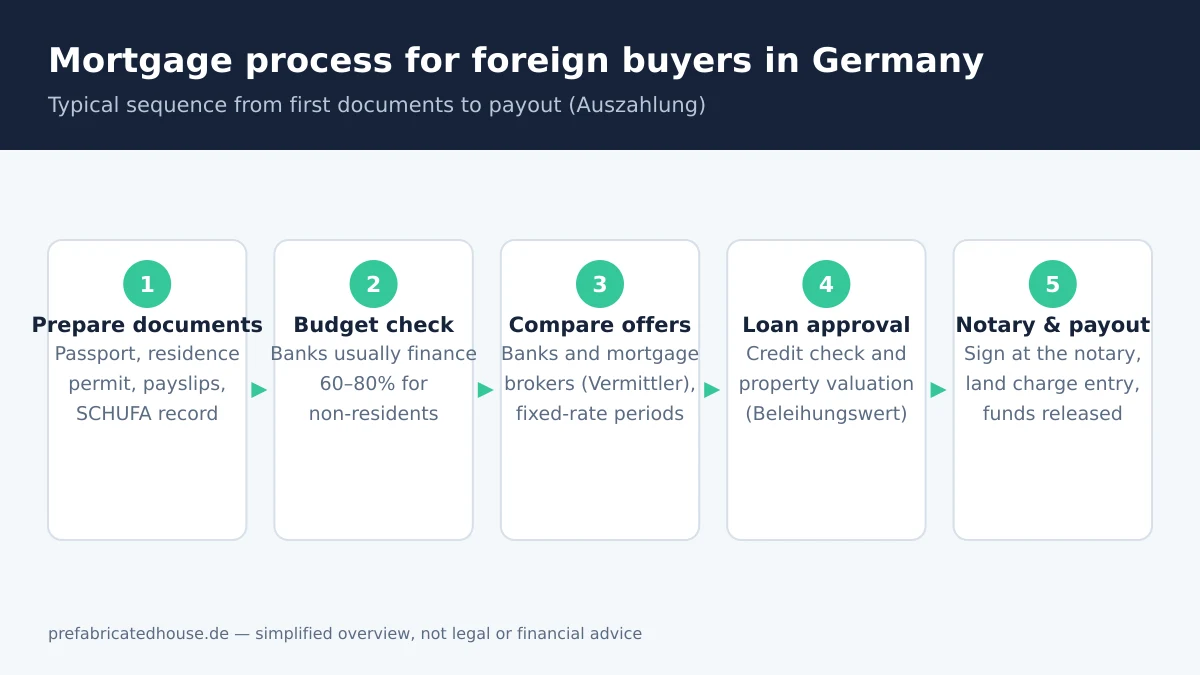
The rest of this guide walks through the whole journey: how your residence status shapes what a bank will offer, how much equity you realistically need, what the SCHUFA credit bureau does, how the standard German annuity loan and its fixed-interest period work, what the early-repayment penalty means, the ancillary costs you must pay from your own pocket, the timeline to payout, the most common reasons applications fail, and whether to work through a broker or approach a bank directly.
Bank requirements by residence status
The single biggest factor in a German mortgage decision for a foreigner is your legal status in the country. Banks lend for decades, so they want confidence that you will remain resident and solvent for the life of the loan. Broadly, applicants fall into three groups, each treated differently.
EU and EEA citizens living in Germany are usually treated almost like German nationals. With a permanent German employment contract and a positive credit record, they can often finance 80–90% of the property value on standard terms. Freedom of movement removes most of the residence uncertainty that worries a lender.
Non-EU citizens resident in Germany depend on the strength of their residence title. A permanent settlement permit (Niederlassungserlaubnis) or an EU Blue Card is viewed very favourably, while a temporary residence permit (Aufenthaltstitel) valid for only 12 or 24 months makes banks cautious, because the paper may expire long before the loan is repaid. As orientation for 2026, a permit with at least 3 years remaining materially improves your chances.
Non-residents living abroad face the strictest terms. Here a bank cannot rely on German income or an established local footprint, so it lowers the loan-to-value ratio sharply — frequently requiring 40% or more of the value as equity. Some banks simply do not lend to non-residents at all, which is why comparing several lenders matters. If you are still weighing whether to build from abroad, our hub for international buyers gives the wider picture.
Three things every foreign applicant should prepare
40%+ equity for non-residents
As of 2026, applicants living abroad often need at least 40% of the property value as equity, plus 9–12% ancillary costs from savings.
SCHUFA credit record
German banks query the SCHUFA credit bureau. Newcomers have no history yet, so income, residence status and equity carry more weight.
Documents & translations
Passport, residence permit, proof of income, bank statements and evidence of equity. Foreign-language papers usually need a certified translation.
Equity expectations: why non-residents need 40%+
German banks measure how much they will lend as a share of the property value, the loan-to-value ratio (Beleihungsauslauf). The lower the ratio, the more of your own money you must contribute as equity (Eigenkapital). For non-residents, lenders keep the ratio conservative because they cannot easily enforce against a borrower who lives abroad and cannot observe a German income stream month after month.
In practice, that means an applicant living outside Germany should plan for at least 40% equity on the property value in 2026, and it is not unusual to see requirements of 50% for smaller or less liquid properties. An EU expat with German income might only need 10–20% equity, so your status can swing the deposit by tens of thousands of euros on the same house. On a €400,000 home, a 40% requirement means €160,000 of your own money before a single ancillary cost.
Crucially, the ancillary purchase costs sit on top of the deposit and usually cannot be borrowed. Between the transfer tax and the fees, expect another 9–12% of the price, and banks want to see that this too comes from your savings. To model a realistic budget before you talk to a lender, our cost calculator and the prefab house prices overview are good starting points.
SCHUFA and building a German credit profile
SCHUFA is Germany's dominant private credit bureau, and virtually every bank queries it before approving a mortgage. Your SCHUFA score is expressed as a percentage, and a value above roughly 95% signals low risk to a lender. Negative entries — unpaid debts, defaults, enforcement — can sink an application on their own.
If you are new to Germany you will usually have no SCHUFA record yet. This is not a black mark, but it does leave the bank with thin data, so it leans harder on your income, residence status and equity to make the decision. You can request one free self-disclosure (Bonitätsauskunft) per year to see what is stored about you; the official SCHUFA consumer information explains how. Over 6 to 12 months, holding a German current account, paying rent and bills on time, and servicing any small credit responsibly steadily builds a profile that widens your borrowing options.

The annuity loan, fixed-interest period and early repayment
The standard German home loan is the annuity loan (Annuitätendarlehen). You pay a constant monthly instalment made up of interest and repayment (Tilgung). At the start most of the payment is interest; as the balance falls, the repayment portion grows while the total instalment stays the same. Your chosen initial repayment rate matters enormously — a 2% rate clears the loan far more slowly than a 3% rate, so many buyers pick 2% or 3% depending on how fast they want to be debt-free.
German rates are typically locked for a fixed-interest period (Zinsbindung), commonly 10, 15 or 20 years. A longer lock buys certainty at a modestly higher rate; for 2026 a 15-year fix is a popular middle ground. If you repay a fixed-rate loan early — for example when selling — the bank may charge an early-repayment penalty (Vorfälligkeitsentschädigung) to cover its lost interest, which can run to several thousand euros on a mid-sized loan. One protection is fixed in law: under the German Civil Code you can always terminate any loan without penalty 10 years after full payout, giving 6 months' notice, whatever the agreed fixed period. The rule sits in § 489 BGB.
Ancillary costs and the path to payout
Beyond the deposit, every buyer pays ancillary purchase costs (Kaufnebenkosten) that the mortgage usually will not cover. The largest is the real-estate transfer tax (Grunderwerbsteuer), set by each federal state between 3.5% and 6.5% of the price. On top come notary (Notar) and land-registry (Grundbuch) fees of roughly 1.5–2% together, and an estate-agent commission where an agent is involved. Altogether these add about 9–12% of the price. The full breakdown by state is in our property taxes & Grunderwerbsteuer guide.
The path to payout is fairly predictable. You gather documents, obtain a financing indication, agree the purchase, sign at the notary, and the bank releases funds after registering its charge on the property. A clean case often takes 4 to 8 weeks, but cross-border files with certified translations can run longer. For a new build the money is not paid as one lump sum: instead it is disbursed in stages against construction progress, so aligning your loan with the builder's payment plan is essential. If your build still needs a permit, our guide to the building permit in Germany explains that parallel process, and possible support is covered in our subsidies overview.
Common reasons for rejection — and broker vs direct bank
Most declined applications from foreigners fail for a handful of recurring reasons: too little equity, income that is unstable or hard to verify, a residence permit that expires too soon, no SCHUFA data, or an incomplete file. Roughly 1 in 3 weak applications founders on equity alone. Non-euro income is another sticking point, because exchange-rate swings add risk and can trigger a premium of around 0.2–0.5 percentage points, and some banks decline it outright. The good news is that most of these are fixable — a larger deposit, certified translations, a renewed or longer permit, and a tidy, complete file frequently turn an initial no into a yes.
Finally, decide how to shop for the loan. A direct bank sells only its own products, so you see a single lender's view. A mortgage broker (Vermittler) compares many banks at once and often knows which lenders actually work with foreign income and non-resident status — a real advantage for international buyers. Brokers are usually paid a commission by the lender, so their service is typically free to you, though you should always confirm that before signing anything. Either way, compare at least 3 offers: over a 15-year fixed term, even a small rate difference can mean thousands of euros. Once your budget is clear, browse prefab house designs or specific manufacturers to firm up a price the bank can assess.
Keep reading
Fix your house price — then arrange financing
- Free & non-binding
- SSL-encrypted
- Reply within 24 h
Which type of prefab house fits your plans?
Personal reply within 24 hours
FAQ: getting a mortgage in Germany as a foreigner
Answers on residence status, equity, SCHUFA, the annuity loan, costs and the timeline to payout — general orientation for 2026, not financial advice.
Can a foreigner get a mortgage in Germany at all?
How much equity do non-residents usually need?
What is SCHUFA and why does it matter?
What is an annuity loan (Annuitätendarlehen)?
How long should the fixed-interest period be?
What is a Vorfälligkeitsentschädigung?
What ancillary purchase costs come on top of the loan?
How long does the process take until payout?
What are the most common reasons for rejection?
Should I use a mortgage broker or a direct bank?
Can I use income and savings from abroad?
What residence status do banks prefer?
As of 2026, this is research and general information only — not financial advice. Prefabricated House is an independent comparison portal and is not a bank, mortgage broker or financial adviser. All figures are indicative and vary by lender, income, residence status and property. Obtain a binding offer from a licensed provider before committing.
