
Building a prefab house in Germany: step by step for foreigners
Buying and building a prefab house (Fertighaus) in Germany follows a clear, well-regulated path. This guide walks you through every stage — from your first budget and financing certificate to the day you register your new address — with realistic durations at each step, written for international buyers.
Building your own home in a country you did not grow up in can feel daunting, but Germany's process is orderly and predictable once you understand the sequence. The same regulated steps apply whether you are a returning German citizen, an EU expat already working here, or a non-resident buying from abroad. What changes for foreigners is mainly the financing terms and the amount of translation and documentation you will need to organise along the way.
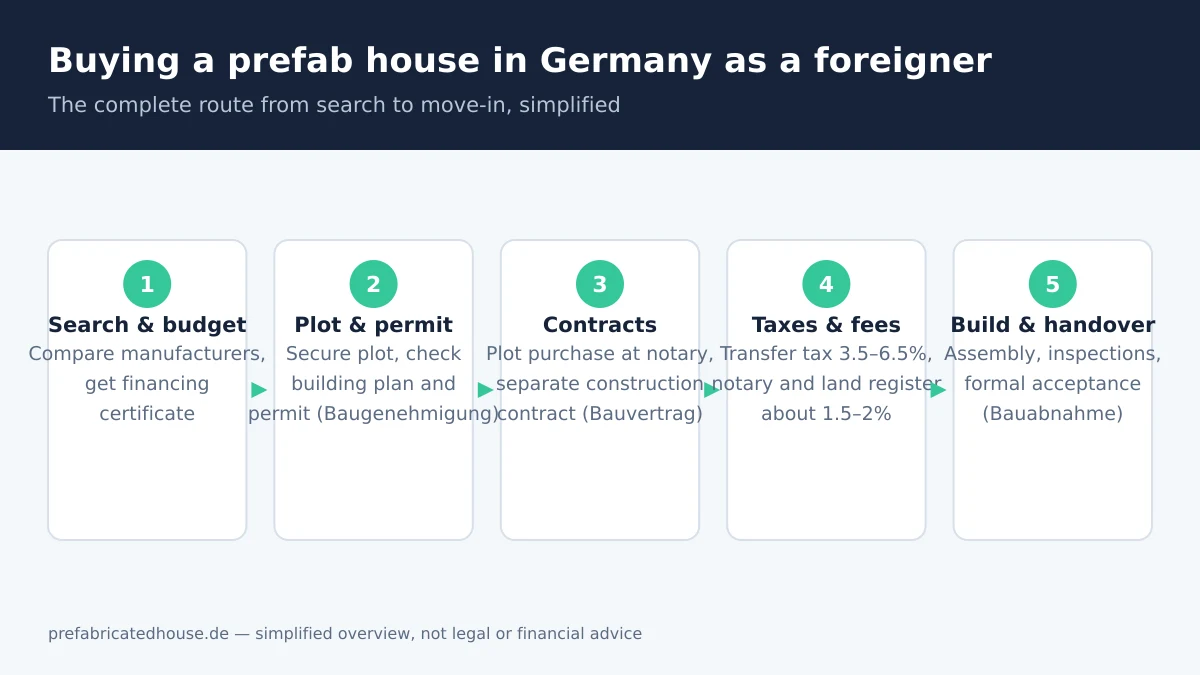
The whole journey usually spans about 12 to 24 months. The prefab house itself is manufactured in a factory and erected on site in a matter of days, so counter-intuitively it is rarely the house that sets the pace. Instead, three things dominate the calendar: finding a suitable building plot, obtaining the building permit, and arranging financing. The eleven numbered steps below take these in the order you will actually meet them, each with a realistic time estimate so you can plan trips, notice periods and payments with confidence.
What to expect on the journey
11 clear stages
From your financing certificate to the Anmeldung, each step is numbered with a realistic duration so you always know what comes next.
12–24 months total
A prefab shell goes up in days, but plot search, permit and financing shape the timeline. Start the plot hunt on day one.
Paperwork made plain
German terms — Bebauungsplan, Werkvertrag, Unbedenklichkeitsbescheinigung — explained in context so nothing catches you out.
The step-by-step route, in order
Set your budget and get a financing certificate
Duration: 2–4 weeks
Before you look at plots or houses, decide how much you can realistically spend and secure a written financing confirmation (Finanzierungsbestätigung) from a bank or an independent, regulated mortgage adviser. This one-page document states the loan amount a lender is willing to provide in principle, and sellers and notaries take you far more seriously when you have it. As a non-resident you should expect a lower loan-to-value ratio and a larger equity requirement — often 30–50% of the price plus the ancillary costs.
Add the full picture together: the house price, the plot, and roughly 9–12% of the price in ancillary purchase costs (transfer tax, notary, land registry and any agent fee). For an early estimate of the house element, use our cost calculator and compare typical prefab house prices.
Search for the right building plot (Grundstück)
Duration: 1–6 months
Finding a serviced building plot (Grundstück) is often the slowest part of the whole project, so start early. A plot is only worth pursuing if it is designated as building land (Bauland) and connected — or connectable — to water, sewage, electricity and, increasingly, fibre. Prices per square metre vary enormously: from perhaps €80–200/m² in rural regions to well over €1,000/m² in and around major cities.
For a prefab (Fertighaus) you also need honest access for a large delivery truck and, on assembly day, a mobile crane. A narrow lane, a steep slope or overhead cables can add cost or rule a plot out. Budget several weekends for viewings; good plots in demand regions can sell within days.
Check the local development plan (Bebauungsplan)
Duration: 1–2 weeks
Every plot is governed by the municipality's binding land-use rules, and the key document is the local development plan (Bebauungsplan). It dictates what you may build: the number of full storeys, the permitted roof shape and pitch, the maximum building footprint via the site-occupancy index (GRZ, typically 0.3–0.4), how far the house must sit from boundaries, and sometimes even the colour of the roof tiles.
Request the plan from the municipal building office (Bauamt) before you sign anything, and match it against the house you have in mind. If there is no development plan, the looser rule of §34 of the Building Code applies, meaning your house must simply fit in with the surrounding buildings. Getting this wrong can cost tens of thousands of euros in redesign, so read our building permit guide first.
Choose a manufacturer and sign the construction contract (Werkvertrag)
Duration: 4–10 weeks
Compare several prefab manufacturers on price, the building description (Baubeschreibung), energy standard, warranty and references before you commit. The building description is the technical heart of the deal: it lists exactly what is and is not included, from insulation thickness to the number of power sockets. A vague description is the single biggest source of later cost disputes.
The contract itself is a construction contract (Werkvertrag), governed by German consumer-construction law, which since 2018 requires a clear description and a binding completion date. Have it reviewed by an independent expert before signing, and never pay more than the payment schedule allows. Browse manufacturers and example house designs to shortlist candidates.
The notary appointment for the plot (Notartermin)
Duration: 3–6 weeks
In Germany, every property purchase must be certified by a notary (Notar); a private handshake agreement is legally worthless. The notary is a neutral officer who drafts the purchase contract, reads it aloud in full at the appointment and explains it to both parties. If your German is limited you are legally entitled to bring a sworn interpreter (vereidigter Dolmetscher), and the notary will usually insist on one.
At the signing the notary registers a priority notice (Auflassungsvormerkung) in the land register to protect your claim, then arranges the transfer once the price and taxes are paid. Expect roughly 3–6 weeks from agreeing terms with the seller to the actual appointment, since the notary needs time to prepare and circulate the draft.
Pay the transfer tax and ancillary costs (Grunderwerbsteuer & Nebenkosten)
Duration: 4–8 weeks after signing
Shortly after the notarised purchase, the tax office sends you the assessment for the real-estate transfer tax (Grunderwerbsteuer). The rate is set by each federal state and ranges from 3.5% in Bavaria and Saxony up to 6.5% in North Rhine-Westphalia, Brandenburg, Saarland and Schleswig-Holstein; several states sit at 5.0–6.0%. You normally have about four weeks to pay after the assessment arrives.
Only once the tax office confirms payment with a clearance certificate (Unbedenklichkeitsbescheinigung) can the court register you as the owner. On top of the tax, budget notary and land-registry (Grundbuch) fees of around 1.5–2% and any estate-agent commission. See the full breakdown in our taxes and fees guide.
Apply for the building permit (Baugenehmigung)
Duration: 6–16 weeks
Almost every new house needs a building permit (Baugenehmigung) issued by the local building authority. Your manufacturer's architect usually prepares the application — site plan, floor plans, structural calculations, an energy certificate and a drainage plan — and submits it on your behalf. Processing times vary widely by region and workload, from about six weeks in efficient districts to four months or more elsewhere.
In some states, simpler homes inside a valid development plan qualify for a faster notification procedure (Genehmigungsfreistellung) instead of a full permit. Do not order the foundation or schedule assembly until the permit is legally in force, because building without one risks a stop-work order and heavy fines.
Prepare the ground: base slab or cellar (Bodenplatte/Keller)
Duration: 3–6 weeks
A prefab house is only as good as what it stands on, so the groundworks come next. You will decide between a ground slab (Bodenplatte) and a full cellar (Keller). A slab is cheaper and quicker, while a cellar typically adds €30,000–60,000 but creates valuable storage and technical space. A soil survey (Baugrundgutachten) is strongly recommended so the foundation is engineered for your actual ground conditions.
This stage also connects the house to the utility grid: water, sewage, electricity and telecoms. Coordinate the timing carefully, because the base must be fully cured and precisely level before the prefab modules can be craned into place — a slab that is a few centimetres out can delay the whole assembly.
Assembly day: erecting the house (Montage)
Duration: 1–3 days on site
The moment that makes prefab construction so distinctive is the assembly (Montage). The factory-built wall, ceiling and roof elements arrive on lorries and a mobile crane lifts them into position. For a typical single-family house the weatherproof shell is usually closed in just 1–3 days, a striking contrast to months of on-site bricklaying.
After the shell is up, the interior fit-out follows over the next weeks: electrics, plumbing, heating, plastering, screed, flooring and the bathroom and kitchen. Depending on the finishing package you chose — turnkey (schlüsselfertig) or a shell you complete yourself — the interior work runs roughly 8–16 weeks before the house is ready to hand over.
Formal handover and acceptance (Bauabnahme)
Duration: 1 day, plus snagging
The handover inspection (Bauabnahme) is a legally decisive milestone, not a formality. You walk through the finished house with the builder, test everything and record every defect in a written acceptance protocol. Acceptance shifts the risk and the warranty clock to you, so bring an independent building surveyor — their fee of roughly €400–800 is money well spent.
Do not sign off if serious defects remain; you may withhold a reasonable portion of the final payment until they are fixed. Under German law the warranty period for construction defects runs for five years from acceptance, which is why documenting the state of the house on this day matters so much.
Move in and register your address (Einzug & Anmeldung)
Duration: within 2 weeks of moving
Once you receive the keys you can move in, but there is one legal duty every resident in Germany must complete: registering your address (Anmeldung) at the local citizens' office (Bürgeramt). You are required to do this within two weeks of moving in, and you will need your ID or passport and a landlord/owner confirmation (Wohnungsgeberbestätigung).
The registration certificate (Meldebescheinigung) then unlocks day-to-day life: it is needed to open some bank accounts, arrange broadband, tax matters and school places. Also set up your household insurance and the annual property tax (Grundsteuer), and enjoy the home you have built.
Documents to prepare as a foreign buyer
Paperwork is where international buyers most often lose time, so it pays to gather everything early. Banks and notaries in Germany expect original documents, and any document in another language usually needs a certified translation (beglaubigte Übersetzung) by a sworn translator. Ordering translations can take one to two weeks, so do not leave them until the notary appointment is booked.

The core checklist includes a valid passport or ID, recent proof of income (payslips or, for the self-employed, tax assessments), bank statements, evidence of your equity and its source, and your employment or residence status where relevant. For the property itself you will need the construction contract (Werkvertrag), the building description, the plot details and the development plan (Bebauungsplan). Keeping digital scans in one folder lets you respond to any request within a day rather than a week.
It is also worth budgeting for the professionals who protect you along the way: an independent expert to review the construction contract, a surveyor for the handover inspection at roughly €400–800, and, if you buy to let, a tax adviser (Steuerberater). These fees are small next to a six-figure project, yet they routinely save far more than they cost. To compare the cost building blocks in detail, see our cost calculator and the overview of subsidies.
Keep reading
Mortgage for expats
Loan-to-value, Schufa and the documents banks ask for.
Taxes & Grunderwerbsteuer
Transfer tax by state, notary fees and annual Grundsteuer.
Building permit in Germany
How the Baugenehmigung and development plan work.
Prefab house prices
Typical price ranges for prefab homes in Germany.
Manufacturers
Compare prefab manufacturers and their references.
For internationals hub
All our guidance for foreign buyers in one place.
Ready to start? Compare prefab offers first
- Free & non-binding
- SSL-encrypted
- Reply within 24 h
Which type of prefab house fits your plans?
Personal reply within 24 hours
FAQ: building a house in Germany step by step
Answers on timelines, equity, the notary, permits, assembly, handover and registration — general orientation for foreign buyers as of 2026.
How long does the whole process take from budget to move-in?
Can I complete the whole process without living in Germany yet?
What is the single biggest delay to expect?
Do I really need a notary for the plot purchase?
How much equity do I need as a foreign buyer?
When exactly do I pay the transfer tax (Grunderwerbsteuer)?
How long does a building permit take?
How quickly is a prefab house actually assembled on site?
What happens at the handover inspection?
Do I have to register my address after moving in?
Should I choose a base slab or a cellar?
Are there grants or subsidies foreigners can use?
As of 2026, general information only, provided without warranty. Durations, costs and procedures vary by federal state, municipality and your personal situation. Prefabricated House is an independent comparison portal and does not provide legal, tax or financial advice. For binding guidance, consult a notary, a German tax adviser (Steuerberater) or a licensed lender.
