
The notary appointment and the language barrier
Every property purchase in Germany is certified by a neutral notary (Notar). This guide explains the notary's role, the 14-day consumer review period, your right to an interpreter under § 16 BeurkG, powers of attorney, the fees and exactly what happens during the appointment.
The role of the notary: neutral and mandatory
In Germany, buying land or a house is not a matter of signing a private agreement. The law requires that the purchase contract (Kaufvertrag) be certified by a notary (Notar); without this notarisation the transaction simply has no legal effect. This is unfamiliar to many international buyers who come from systems where a solicitor or an attorney handles the deal, or where a signed private contract is enough. The German notary is a public office holder, not a party's lawyer, and this distinction shapes everything about the appointment.
Crucially, the notary is neutral. He or she does not represent the buyer or the seller, does not negotiate on anyone's behalf and does not judge whether the price is fair or the house is a good investment. Instead the notary has a statutory duty to advise both parties impartially (Belehrungspflicht), to ensure the deed reflects what everyone actually intends and to warn of legal risks. If you want someone fighting for your interests, you still need your own lawyer or adviser alongside the notary. The notary's job is to guarantee a lawful, clear and enforceable contract that protects both sides equally.
Because the notary is neutral and the fees are fixed by statute, it makes no financial difference which notary you use. Either party may propose one, and in practice the buyer often does. If you are still comparing houses and manufacturers before you reach this stage, our overview of prefab house prices and the cost calculator help you arrive at the notary with a realistic budget.
Three protections you should know
14-day review period
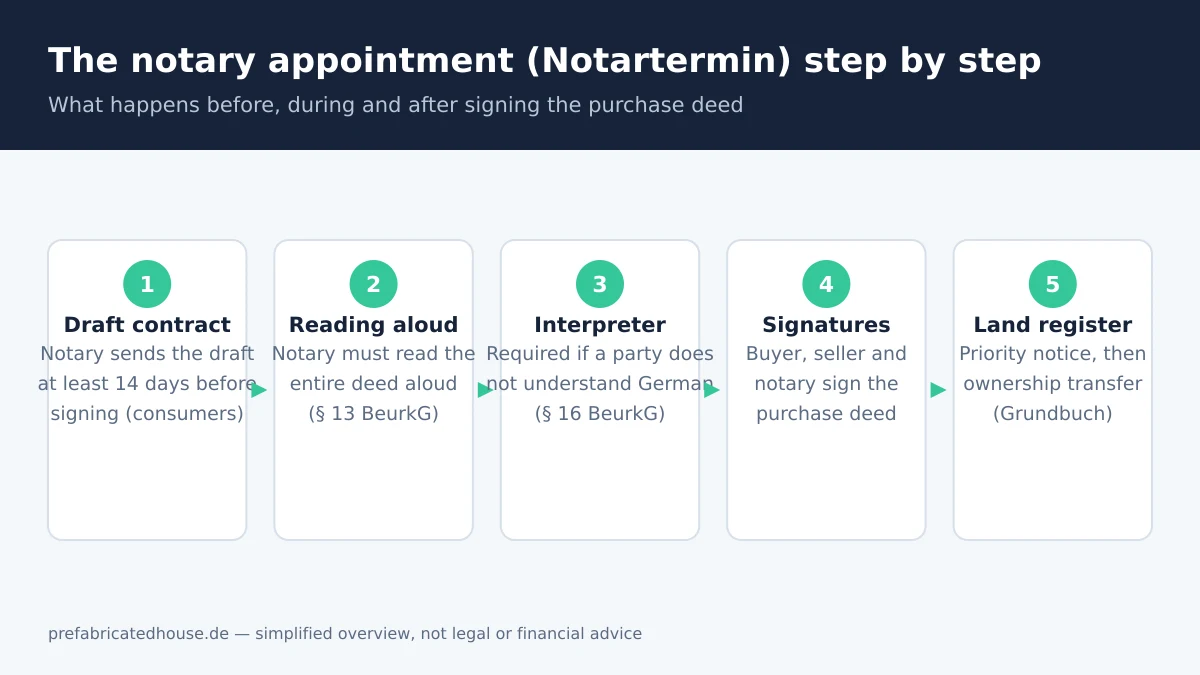
For consumers the notary must send the draft deed at least 14 days before the appointment (§ 17 (2a) BeurkG) — time to read and translate it.
Interpreter is mandatory
If you do not speak German, § 16 BeurkG requires a sworn interpreter (Dolmetscher) or a written translation before the deed is signed.
Notary & registry ~1.5–2%
Statutory notary and land-registry (Grundbuch) fees together are roughly 1.5–2% of the purchase price and are the same at every notary.
The 14-day review period for consumers
One of the most important consumer protections in a German property purchase is the statutory waiting period. Under § 17 (2a) BeurkG (the German Notarisation Act), when a consumer buys from a business the notary must make the finished draft deed available at least 14 days before the appointment. The idea is to give you enough time to read the contract carefully, seek independent advice and prepare your questions, rather than being handed a complex legal document for the first time on the day you are expected to sign it.
For a foreign buyer these two weeks are especially valuable. Use them to arrange a written translation of the draft, to line up your financing and to confirm that the plot details, the building description and the payment schedule all match what you agreed. The waiting period can be shortened in some situations, but as an international buyer you should almost always keep the full 14 days. If anything is unclear, the notary is obliged to explain it before you sign, but reading in advance means you arrive informed rather than under pressure.
The review period runs alongside the wider paperwork of building in Germany. Before the notary stage you will typically have secured the plot, chosen a manufacturer and, in many cases, started the building permit process. Understanding how these documents connect is covered further in our guide to working with German contracts.
§ 16 BeurkG: your legal right to translation
The language barrier is the single biggest concern for international buyers at the notary, and German law addresses it directly. Under § 16 BeurkG (German Notarisation Act), if a party to the deed is not sufficiently proficient in German, the notary may not simply proceed as normal. Instead the written record (Niederschrift) must be translated for that party, either by the notary in writing or through a sworn interpreter (Dolmetscher) who is brought in for the appointment and translates the deed as it is read aloud.
This is not optional courtesy — it is a binding legal requirement. A deed certified without meeting the § 16 BeurkG safeguards can be challenged, so notaries take it seriously. In practice you have two routes. Either you receive a full written translation of the deed that you have read before the appointment, or a qualified interpreter attends and orally renders every clause into your language while the German original is read out. The interpreter must be neutral and, on request, may have to affirm the accuracy of the translation.
Interpreter fees are normally your responsibility as the buyer and, as of 2026, typically range from about €80 to €150 per hour, with most appointments needing at least 2 hours. Because the reading with live translation takes longer, allow close to 2 hours for the appointment itself. Arrange the interpreter early — a good sworn interpreter for your language may be booked out several weeks ahead, and the notary cannot proceed without one if you do not understand German.
The reading duty and how the appointment runs
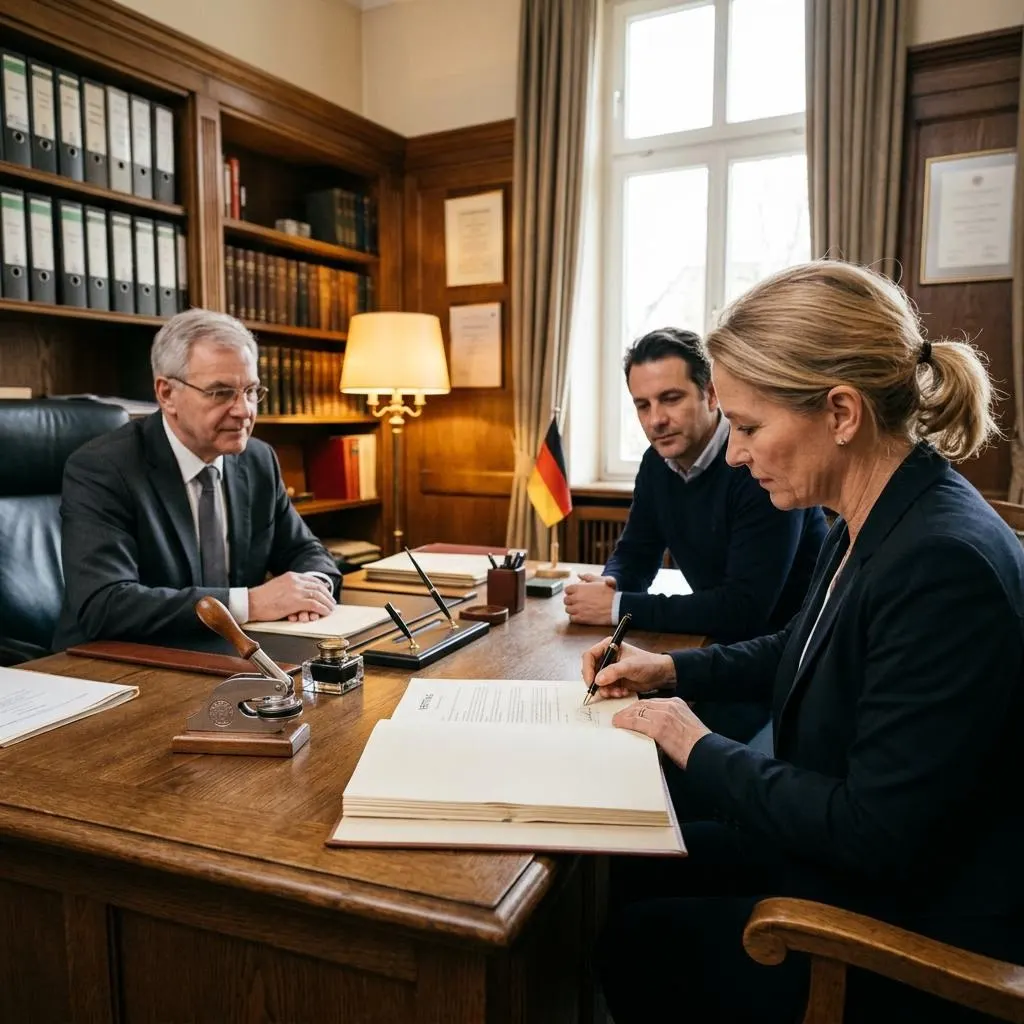
A German notarisation is a formal event, and its centrepiece is the reading duty (Verlesungspflicht). The notary must read the entire deed aloud from start to finish in the presence of all parties before anyone signs. Nothing may be skipped, even if everyone insists they have already read and understood the text. Where an interpreter is present, the deed is read in German and translated section by section. For a typical house or plot purchase this takes around 45 to 90 minutes, or closer to 2 hours with translation.
The appointment usually follows a clear sequence. First the notary checks everyone's identity against a valid passport or ID and confirms who is present, including any interpreter or holder of a power of attorney. Next the deed is read aloud and the notary pauses to explain important clauses — the price, the payment conditions, warranties, handover and the register entries. Parties may ask questions and, if needed, small corrections can be noted. Only then does everyone sign, followed by the notary. There is no fee negotiation at the table; the statutory scale (GNotKG) fixes the cost.
After signing, the notary drives the process forward. The first step is usually registering a priority notice (Auflassungsvormerkung) in the land register (Grundbuch), which reserves your position as future owner and stops the seller from reselling or re-mortgaging the plot. The notary then obtains the tax clearance certificate, checks that any old mortgages are cleared and only then issues the payment request. The whole path from signature to full ownership commonly takes 2 to 3 months.
Powers of attorney, fees and the priority notice
Many international buyers cannot easily fly to Germany for the appointment. The standard solution is a power of attorney (Vollmacht): you authorise a trusted person to sign the deed on your behalf. Because the underlying transaction must be notarised, the power of attorney itself usually needs to be certified, which can cost roughly €50 to €200 depending on its scope. Arrange it at least 2 weeks ahead so the certified document, and any apostille or translation, reaches the German notary in good time.
The notary and land-registry (Grundbuch) fees are not negotiable. They are set by the statutory scale in the Gerichts- und Notarkostengesetz (GNotKG) and depend on the purchase price, so any notary in Germany charges the same for the same deal. Together these fees usually come to about 1.5–2% of the price — on a €400,000 purchase, roughly €6,000 to €8,000. This is separate from the real-estate transfer tax, which our property taxes guide covers in detail.
Finally, do not underestimate the priority notice. The Auflassungsvormerkung is the single mechanism that protects your money and your claim during the weeks between signing and final ownership. Once it is entered, the seller cannot dispose of the plot behind your back, and your purchase price is only requested after the notary confirms the protective conditions are met. For the financing side of all this, see our mortgage guide for expats and the available subsidies.
Get a clear house price before the notary
- Free & non-binding
- SSL-encrypted
- Reply within 24 h
Which type of prefab house fits your plans?
Personal reply within 24 hours
FAQ: the German notary appointment
Answers on the notary's neutral role, the 14-day period, interpreters under § 16 BeurkG, powers of attorney, fees and the appointment itself — as of 2026, general orientation only.
Is a notary really required to buy property in Germany?
What does the 14-day review period mean for me?
Do I need an interpreter at the notary appointment?
How much do notary and land-registry fees cost?
What is the Auflassungsvormerkung and why does it matter?
How long does the notary appointment itself take?
Can I sign through a power of attorney instead of attending?
When do I actually pay the purchase price?
Does the notary check whether the price or house is fair?
What documents must I bring to the appointment?
Can I get the deed translated into English in advance?
What happens after I have signed?
As of 2026, general information only, provided without warranty. This page does not constitute legal advice and cannot replace the individual advice of your notary (Notar) or lawyer. Fees, deadlines and procedures depend on your contract, the state and your situation. Prefabricated House is an independent comparison portal and does not provide legal services. For binding guidance, consult a German notary or lawyer.
