
Construction Interest Forecast 2026 to 2030: Three Scenarios in a Corridor
Where are construction interest rates heading by 2030? This cannot be answered reputably with a single figure. This guide shows three plausible scenario corridors – optimistic, base and pessimistic – from 3.6 to 4.3 percent in 2026, clearly marked as scenarios, and explains the influencing factors.
Where are construction interest rates (Bauzinsen) heading by 2030? This question decides the monthly instalment for tens of thousands of prospective builders. It cannot be answered responsibly with a single number — it makes far more sense to look at plausible scenarios. This guide sets out three corridors for the years 2026 to 2030 and explains which factors determine the direction.
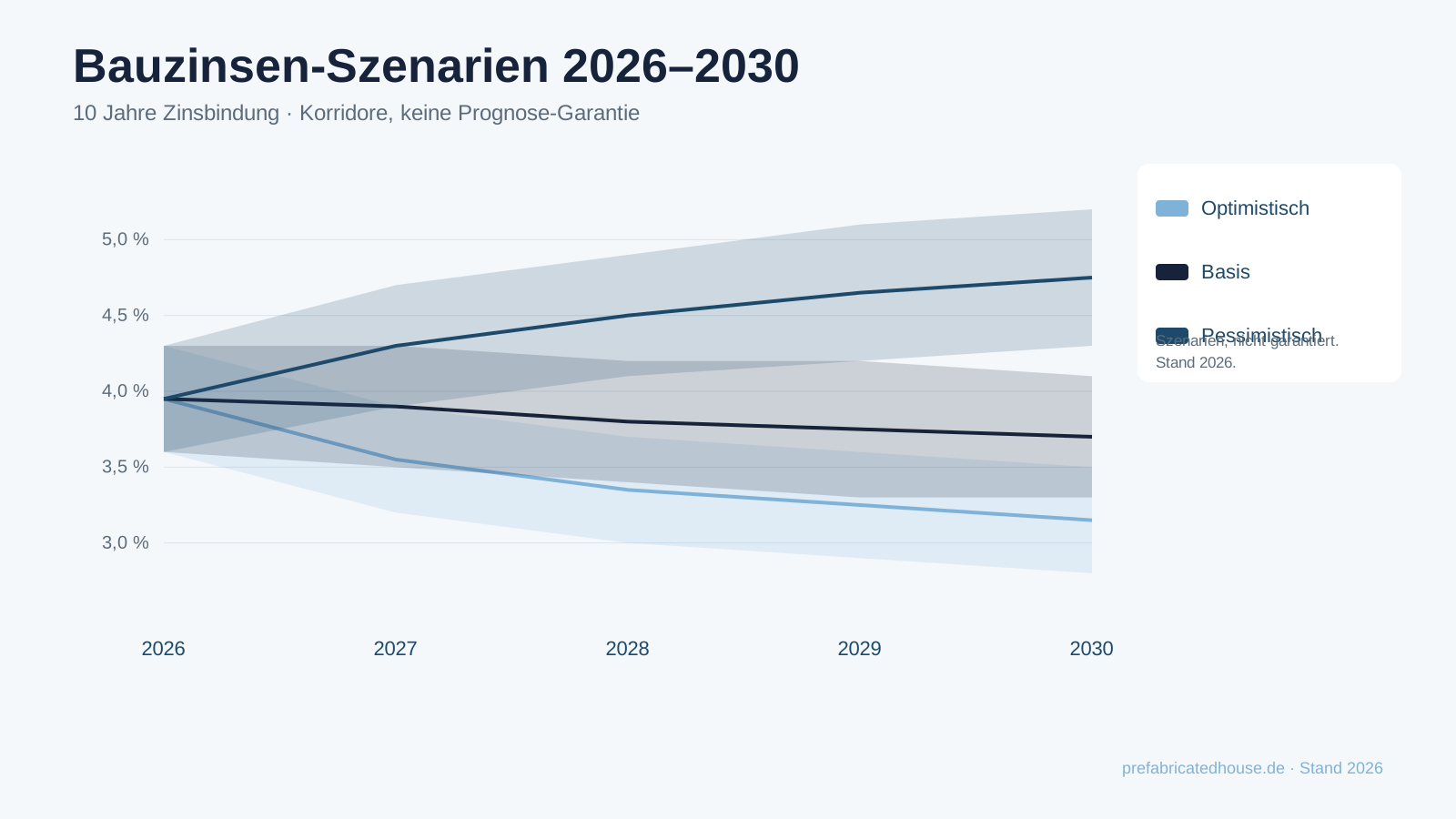
Short answer: As of 2026, construction interest rates for a 10-year fixed-interest period (Zinsbindung) stand at roughly 3.6 to 4.3 percent. For 2026–2030 three scenarios are plausible: an optimistic one (slightly falling towards 2.8–3.5 %), a baseline scenario (largely sideways, 3.3–4.3 %) and a pessimistic one (rising to 4.3–5.2 %). None of these figures is guaranteed.
How high are construction interest rates right now?
Short answer: For a 10-year fixed-interest period, borrowers typically pay 3.6 to 4.3 percent in 2026. Shorter fixed periods sit somewhat below this, while longer ones of 15 or 20 years tend to be above it. The exact terms depend on creditworthiness, equity and the loan-to-value ratio.
The interest rate on construction financing mainly follows the yield on long-dated German government bonds (Pfandbriefe). This in turn reacts to inflation, the economic cycle and the key-rate policy of the European Central Bank. You will find current figures and an overview of terms on the page current construction interest rates.
Which interest-rate scenarios are plausible through 2030?
Short answer: Instead of a point forecast, three corridors make sense: optimistic with slightly falling rates, baseline with largely sideways rates, and pessimistic with rising rates. Which path materialises depends above all on inflation and ECB policy — none of them can be planned for with certainty.
Scenario corridors for 10-year construction interest rates (plausible ranges only, no guarantee)
| Year | Optimistic | Baseline | Pessimistic |
|---|---|---|---|
| 2026 | 3.6–4.3 % | 3.6–4.3 % | 3.6–4.3 % |
| 2027 | 3.2–3.9 % | 3.5–4.3 % | 3.9–4.7 % |
| 2028 | 3.0–3.7 % | 3.4–4.2 % | 4.1–4.9 % |
| 2029 | 2.9–3.6 % | 3.3–4.2 % | 4.2–5.1 % |
| 2030 | 2.8–3.5 % | 3.3–4.1 % | 4.3–5.2 % |
Explicitly scenarios, not a forecast guarantee
Interest-rate movements over several years cannot be predicted responsibly. The three corridors describe possible paths under different assumptions. They are neither a prediction nor an investment or financing recommendation.
Which factors drive construction interest rates?
Four variables determine the direction. First, inflation — if it stays close to the ECB's 2-percent target, the pressure on rates eases. Second, the ECB's monetary policy, whose key-rate decisions shape short-term refinancing costs. Third, the economic cycle: in a recession, yields tend to fall, while strong growth pushes them up. Fourth, public debt and geopolitical risks, which can unsettle the bond markets.
Because these factors partly work against each other, a sideways baseline scenario is the most plausible for 2026. For your decision between building now and waiting, the guide Build now or wait? can help.
How can you protect yourself against rising interest rates?
Anyone who fears the pessimistic scenario has several levers. A long fixed-interest period of 15 or 20 years locks in today's rate. A forward loan (Forward-Darlehen) secures the terms for a later drawdown — for a surcharge. More equity lowers the loan-to-value ratio and therefore the interest rate. And a higher initial repayment rate shortens the remaining debt before a follow-up financing becomes due. The repayment calculator shows how instalment and term behave.
Always compare terms
Between providers there are often several tenths of a percentage point — summed over the entire term, that adds up to a five-figure amount. So obtain several offers before you sign. Details in the guide Construction financing 2026.
How strongly does an interest-rate difference affect the instalment?
Even small interest-rate differences have a big effect over the long term of a construction loan. For a loan of €400,000, one percentage point more interest means roughly €4,000 in additional interest costs per year — over ten years this adds up to a five-figure amount, even though repayments steadily reduce the remaining debt. That is why the question of which scenario you finance in matters at least as much for the monthly instalment as the size of the purchase price. With large financing sums this effect weighs particularly heavily — the guide on construction financing from €500,000 shows what matters here.
Conversely: anyone who does not speculate on an optimistic scenario but instead calculates with the baseline scenario is planning on the safe side. If rates later fall against expectations, you benefit at the follow-up financing stage. If they rise, you have made provision with a long fixed-interest period. The construction financing calculator provides a concrete instalment calculation for your project.
What does a look at the interest-rate history teach us?
A look back puts the current figures in context: in the 2010s, construction interest rates below 2 percent were historically exceptionally low — driven by an extremely expansive monetary policy. The jump above 3 percent in 2022/2023 felt drastic, but it actually brought rates back to a more normal long-term level. Anyone expecting a return to the record lows underestimates how unusual that phase was.
For planning this means: a sideways or only slightly falling interest level is no reason to wait. What matters is whether the monthly instalment fits your budget. The guide Build now or wait? explores this question in depth, while the basics of financing are explained in Construction financing 2026. Whether the instalment fits depends largely on the build cost: you can calculate prefabricated house costs in advance and compare them with the current prefabricated house prices 2026. Once the build is complete, the moving-in checklist guides you through deadlines and re-registrations.
Compare financing and offers
Describe your building project once — we forward it to suitable providers. Free of charge and without obligation, as of 2026.
What does your dream house really cost?
Request suitable quotes from vetted manufacturers for free and compare the prices per square metre for your construction project.
Compare house prices now