
Solar Obligation for New Builds 2026: All 16 Federal States at a Glance
Whether your new build must have a PV system depends on the federal state in 2026. It is mandatory in Baden-Württemberg, Berlin, Bremen, Hamburg, Lower Saxony and NRW, Bavaria has a should-rule and Rhineland-Palatinate a PV-ready obligation. This guide lists all 16 federal states and explains the rules.
Whether your new prefabricated house needs a photovoltaic system depends in 2026 on the federal state (Bundesland) — there is no nationwide solar obligation for new residential builds. This guide lists all 16 federal states, explains the different obligations and shows what this means for your new build in concrete terms. You can first use our calculator to calculate prefabricated house costs and assess your budget realistically.
Short answer: As of 2026, a PV obligation for new residential builds applies in six federal states: Baden-Württemberg, Berlin, Bremen, Hamburg, Lower Saxony (Niedersachsen) and North Rhine-Westphalia (Nordrhein-Westfalen). Bavaria (Bayern) has a "should" rule (Soll-Regelung), Rhineland-Palatinate (Rheinland-Pfalz) a PV-ready obligation (preparing the roof). The remaining states have no state-wide obligation — but municipal statutes may apply.
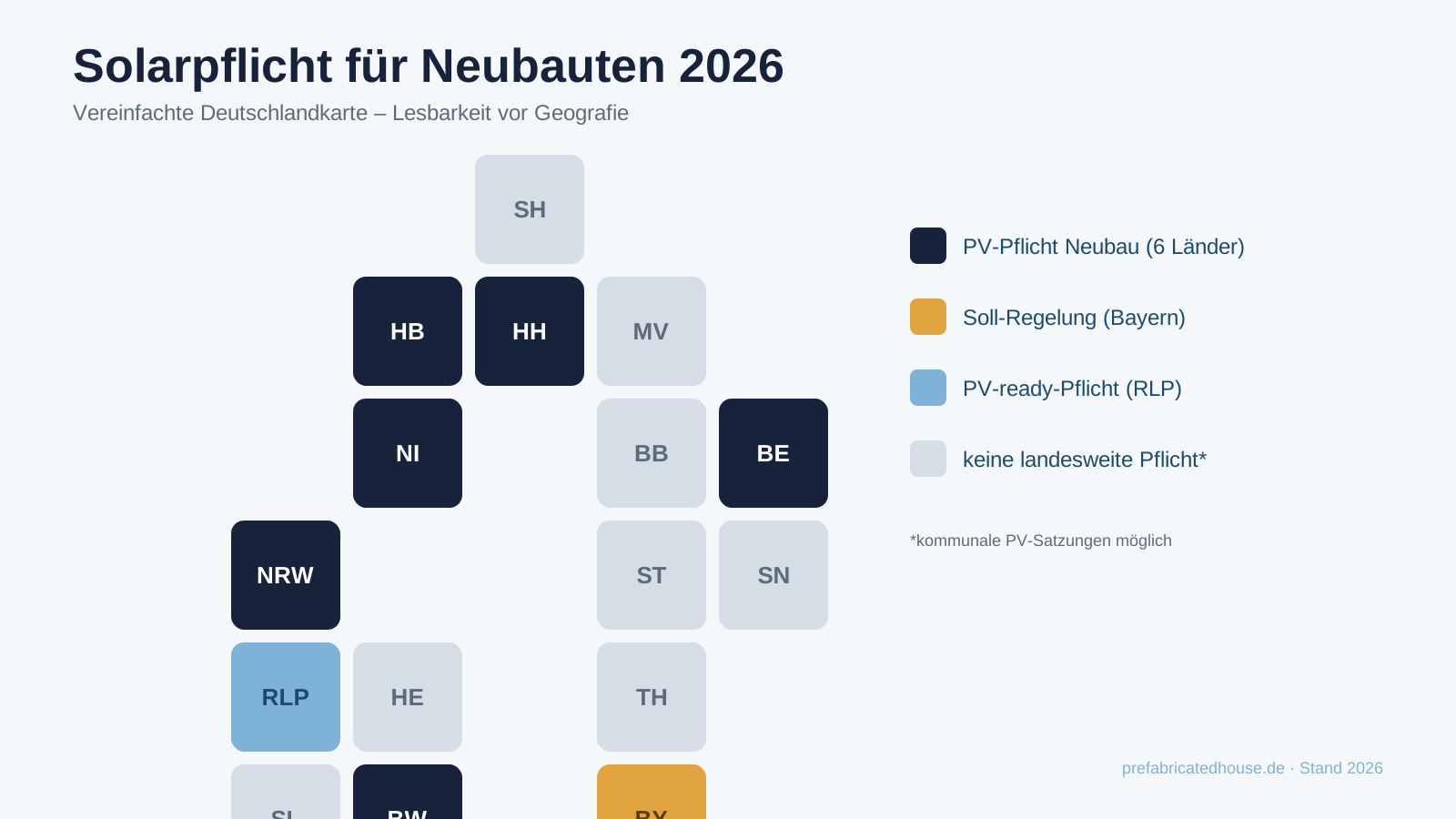
How is the solar obligation regulated in the 16 federal states?
Short answer: Six states mandate PV on new residential buildings, Bavaria uses a "should" wording, and Rhineland-Palatinate at least requires a PV-prepared roof. In the remaining states there is no state-wide residential obligation in 2026, although there are sometimes obligations for commercial buildings, car parks or municipal statutes.
Solar obligation for new residential buildings by federal state (as of 2026)
| Federal state | New build status | Note |
|---|---|---|
| Baden-Württemberg | obligation | PV on new residential buildings |
| Bavaria (Bayern) | "should" rule | recommendation, no hard requirement for residential |
| Berlin | obligation | Berlin Solar Act (Solargesetz Berlin) |
| Brandenburg | no state-wide obligation | municipal statutes possible |
| Bremen | obligation | applies to new builds |
| Hamburg | obligation | Hamburg Climate Protection Act (Klimaschutzgesetz) |
| Hesse (Hessen) | no state-wide obligation | municipal statutes possible |
| Mecklenburg-Vorpommern | no state-wide obligation | municipal statutes possible |
| Lower Saxony (Niedersachsen) | obligation | applies to new builds |
| North Rhine-Westphalia | obligation | PV on new builds |
| Rhineland-Palatinate | PV-ready obligation | roof must be prepared |
| Saarland | no state-wide obligation | municipal statutes possible |
| Saxony (Sachsen) | no state-wide obligation | municipal statutes possible |
| Saxony-Anhalt (Sachsen-Anhalt) | no state-wide obligation | municipal statutes possible |
| Schleswig-Holstein | no state-wide obligation | municipal statutes possible |
| Thuringia (Thüringen) | no state-wide obligation | municipal statutes possible |
Rules change — always check the current status
The state building codes (Landesbauordnungen) and climate protection acts are adjusted regularly; transition periods and exceptions (for example in the case of shading or lack of economic viability) are the norm. Do not rely on this overview alone: ask your building supervisory authority (Bauaufsichtsbehörde) or municipality for the binding status before construction begins.
What do a "should" rule and a "PV-ready obligation" mean?
Not every rule is a hard requirement. Bavaria's "should" rule (Soll-Regelung) phrases PV installation as an expectation but leaves room for discretion — the builder "should", but does not have to in every case. With the PV-ready obligation, Rhineland-Palatinate at least requires the roof to be prepared structurally and electrically so that a system can later be retrofitted without a major rebuild. In the six obligation states, on the other hand, the system must be installed directly with the new build — usually referring to a minimum share of the suitable roof area.
In practice this means: even without a hard obligation, it is almost always worth planning the roof to be at least PV-ready. You can read details on the technology in the guide photovoltaics in the prefabricated house and in combination with storage under PV, storage & wallbox.
Is photovoltaics worthwhile even without an obligation?
Short answer: In most cases yes: self-consumed solar power is significantly cheaper than grid electricity, and in combination with a heat pump and storage, self-consumption rises. A typical system pays for itself over its service life — but profitability depends on roof orientation, consumption and the electricity price.
Anyone combining PV with a heat pump and storage can cover a large part of their electricity needs themselves — right up to an energy self-sufficient house. An overview of system types and funding is also provided by the page solar system as well as the guide GEG for prefabricated houses 2026. Anyone wanting to deepen the basics will find them in the prefabricated house overview.
Which exceptions and transitional rules are there?
No solar obligation applies without exception. As a rule, the state regulations provide for exceptions when installation is technically impossible or economically unreasonable — for example in the case of permanent shading from neighbouring buildings or trees, an unfavourable roof orientation or heritage protection. There may also be relief for very small roof areas or certain types of use. Instead of a classic rooftop system, some states also allow alternative compliance routes, for example solar thermal or a system on an outbuilding.
Because the details vary by federal state and sometimes by municipality, and because the regulations change regularly, clarifying matters early with the building supervisory authority is crucial. It is best to plan the PV system in from the outset — this is usually cheaper than a later retrofit and avoids conflicts with the permit.
How do you sensibly plan the PV system in?
For an economical PV concept, more than mere compliance counts. What matters is a roof area that is as large and unshaded as possible with a south, east or west orientation, a system size matched to the expected consumption, and the question of whether a battery storage system makes sense. Anyone additionally running a heat pump and a wallbox for an electric car benefits especially from a larger system, because self-consumption rises.
Consider the electrical planning early: conduits, meter cabinet and connection points are much easier to provide for during the shell construction than later. On request, a good prefabricated house provider plans PV, storage and charging infrastructure in from the start. Background on technology and yield is provided by the page solar system. How the obligation can be embedded into a well thought-out, CO₂-neutral overall concept is described in the guide on the climate-neutral villa.
Plan a prefabricated house including a PV concept
Describe your project once — we forward it to providers who factor in photovoltaics from the outset. Free of charge and without obligation, as of 2026.
What does your dream house really cost?
Request suitable quotes from vetted manufacturers for free and compare the prices per square metre for your construction project.
Compare house prices now